
Note: I am occasionally updating this post with new information as I think of additional interesting data points to provide, assuming I have the data!
Revision 1.9 – Added paragraph and table regarding human mailboxes vs no reply mailboxes along with the outcome of replying to them.
Revision 1.8 – Greenhouse.io emails DID mention the company in their no reply rejections. Had to kick Claude and myself up the arse on that one.
In September 2025 I was made redundant from Supermassive Games after two and a half years. I wrote about the leaving at the time; this is about the looking. In March 2026 I started as a Senior Systems & Applications Administrator at University of the Arts London. Between those two dates sits seven months of applications, and because I label my email obsessively and LinkedIn will give you your data if you ask, I can tell you exactly what those seven months looked like. So I audited the lot — every labelled Gmail thread, every sent-mail chase, the LinkedIn data export, and the tracking spreadsheet I gave up on — and this is what came out.
The headline numbers
At least 450 applications. I say “at least” because that’s only what left a trace: 317 tracked through email, 90 LinkedIn applications with no email footprint, a dozen-plus speculative emails to studios — and 36 that survive only in the tracking spreadsheet I started on day two and abandoned within a month, when the volume defeated the very idea of tracking. Anything deleted, or applied to through a portal that never wrote back, isn’t counted. The true number is higher and I’ve made peace with never knowing it.
| Stage | Count | Rate |
| Applications (floor) | ~450 | 100% |
| Explicit rejections | 175+ | ~39% |
| Silence — no response of any kind | the rest | ~52% |
| Interview invitations | 33 | ~7% |
| Interviews actually held | 27 | ~6% |
| Rejected after interviewing | 17 | — |
| Offers | 1 | ~0.22% |
Seven months, 205 days from first application to offer, averaging fifteen applications a week — with one week in late July topping fifty. A meaningful chunk went out between 10pm and 3am, including, fittingly, the formal application for the job I actually got, submitted at four minutes past midnight. What can I say? I’m a night owl.
The shape of the thing
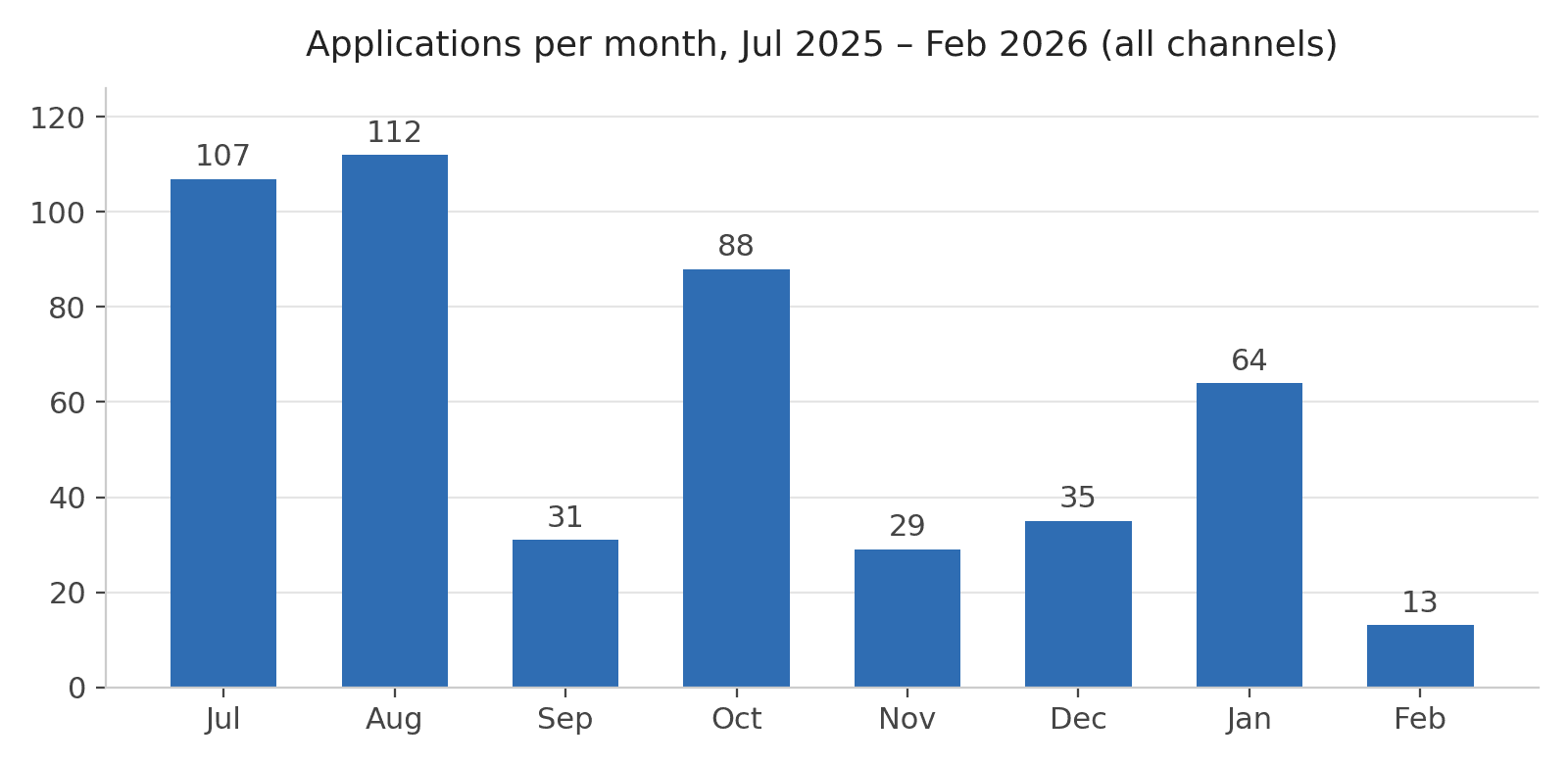
Four phases. A July–August blast of well over two hundred applications, launched while still working my notice. A September lull spent actually interviewing. An October re-surge that seeded the deepest processes of the whole search — two companies took me to three interview stages each, and both processes then died quietly in the December trough, where the entire market goes to hibernate. Then the January push: sixty-four applications, nine interview processes running concurrently, one of which finished the job.
The CV itself kept a version history, and it maps the same terrain. My filenames confess to at least thirty revisions across the seven months — seventeen deployed on LinkedIn alone. The original lasted one week. Six revisions happened in a ten-day sprint in early September; one version then held stable through the whole confident October push; and on the morning of the twin worst rejections of the search I revised it twice in a single day. New Year’s Eve produced two versions before midnight, the first week of January five more — and the thirtieth-odd revision, finished on 7 January, was the one in circulation when the application that ended everything went in two days later. Thirty drafts to learn the document was never the problem.
What was I applying for?
One more cut of the data, with a caveat: job titles only survive for about half the applications — the LinkedIn export, the tracker, and the interview processes — so this is a sample, not a census. But the sample has a clear shape, and it contains the most useful practical finding in this post.
| Role type | Applications | Interviews | Conversion |
|---|---|---|---|
| Support / helpdesk / desktop | 65 | 6 | ~9% |
| Other / specialist | 38 | 3 | ~8% |
| Systems admin/engineer (generalist) | 37 | 8 | ~22% |
| Infrastructure | 24 | 6 | ~25% |
| Cloud / DevOps / Platform / SRE | 22 | 5 | ~23% |
| Linux / Unix explicit | 21 | 3 | ~14% |
| IT management | 9 | 0 | 0% |
| Security | 8 | 1 | 13% |
| Windows / Microsoft explicit | 5 | 1 | 20% |
And we can also break this down by the level of job I was applying for — a different cut of the same 229 titles, so the buckets overlap: an “IT Support Manager” counts as support in the table above and as management-titled in this one.
| Title level | Applications | Share | Interviews | Conversion |
|---|---|---|---|---|
| Junior-marked (junior/associate) | 6 | 3% | 0 | 0% |
| Management-titled | 16 | 7% | 1 | 6% |
| Regular (unmarked mid-level) | 175 | 76% | 25 | 14% |
| Senior-marked (senior/lead) | 32 | 14% | 7 | 22% |
The single biggest thing I applied for was a step down. Support, helpdesk and desktop roles were nearly a third of everything — a senior sysadmin applying for service-desk work, on the theory that surely those would be easy to get. They weren’t. They converted at half the rate of roles at my actual level, presumably because an overqualified applicant doesn’t read as a safe pair of hands; he reads as someone who’ll leave the moment something better appears. Meanwhile the roles that matched my level — generalist sysadmin, infrastructure, cloud — were about a third of my applications but produced two-thirds of my interviews. The market’s message was consistent: apply at your level. It just took me seven months and 450 data points to hear it.
Two smaller notes. Explicitly-Linux roles barely exist as a category — nine percent of what I applied to, converting poorly — because the market doesn’t advertise for Linux specialists; it advertises “systems administrator” and expects the Linux to come along inside, which at UAL it did. And the down-level applying wasn’t evenly spread: it spiked to about half of everything I sent in August and again in January, the two most stressed stretches of the search, and collapsed to a fifth during the confident October push. The instinct under pressure is to apply beneath yourself. The data says it converts worse, not better. If you’re in the tunnel and about to fire off a dozen helpdesk applications at 2am as insurance: I understand completely, and the numbers say send two at your level instead.
Seniority tells the same story with even cleaner numbers. The six explicitly junior roles I applied to — junior Linux, junior cloud, jobs I could have probably done in my sleep — produced zero interviews. Not few. Zero: two rejected me outright and the rest never replied, because nobody believes the overqualified applicant is staying. Management-titled roles converted at 6%, unmarked mid-level roles at 14%, and senior-titled roles — the smallest slice, and the one I actually belonged in — at 22%. The gradient runs perfectly in one direction: every step I aimed below my level cost me conversion, and the job I finally got was senior-titled. The market doesn’t hire insurance. It hires fit.
And there’s a financial twin to all of this. Where application forms demanded a salary expectation — a couple of dozen did — my answers form a time series. On day three of the search I was already asking for less than I was earning. By day six my floor had dropped to roughly a fifth below my salary, and there it stayed for seven months — sometimes “flexible due to redundancy,” twice literally “0” where the form insisted on a number. I was offering a twenty per cent discount and volunteering the reason on the form itself. It converted nothing, because it was the same instinct as the down-level applying, wearing a number: nobody hires insurance, at any price. The roles themselves made the point from both ends — one deskside job I sat two interview rounds for came with a salary more than half below what I’d been earning — I told them in writing that it was acceptable and that I could start immediately; they rejected me within the week anyway, while a fintech Linux role advertising up to £110,000 never replied at all. And the job that ended the search? A 14% pay cut against Supermassive — a real cut, honestly named, and one I can happily live with. Which completes the finding rather neatly: the panic discount converted nothing, and the employer that actually wanted me cost me less than the discount I’d spent seven months offering everyone else.
How fast do rejections arrive?
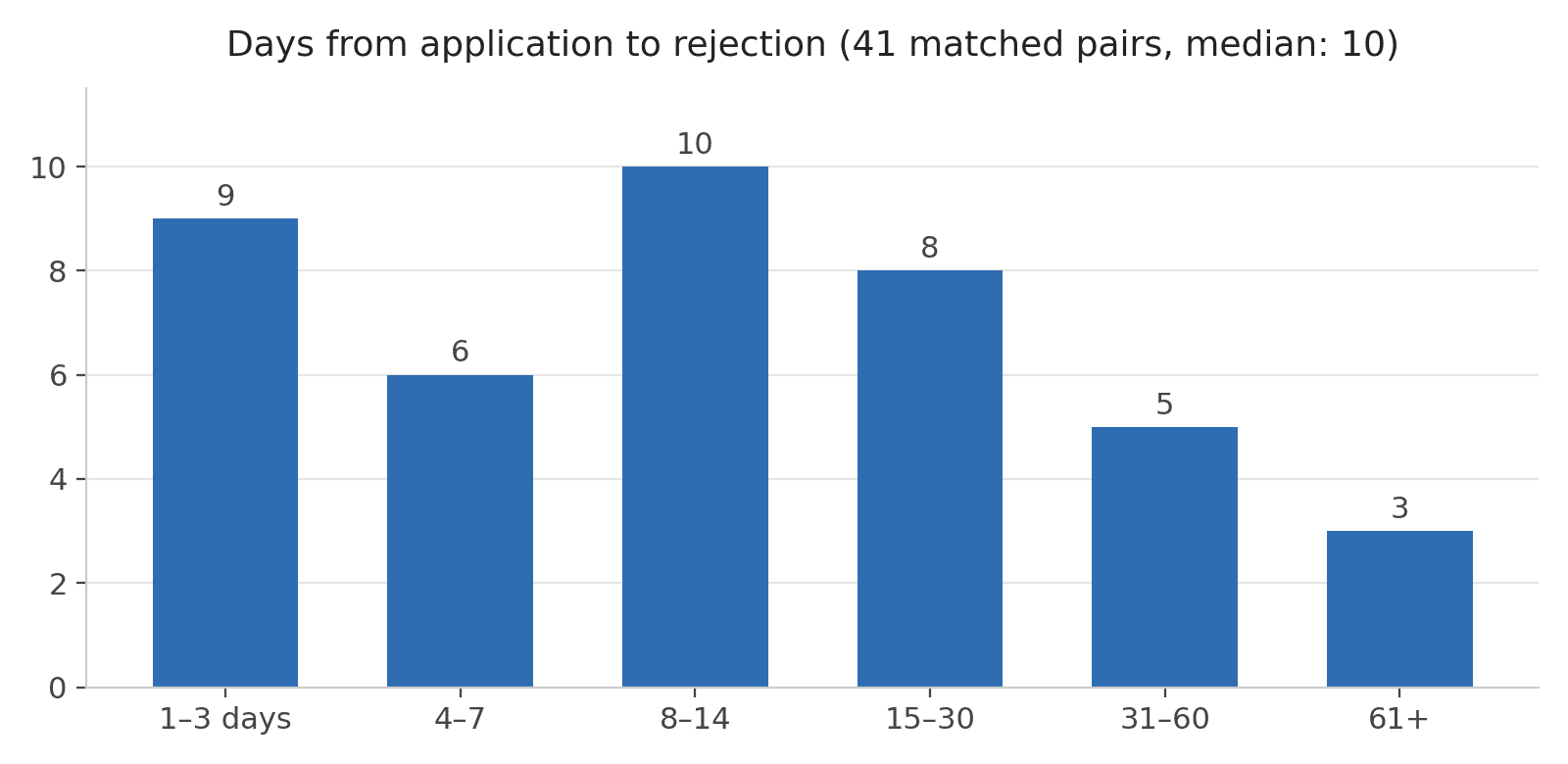
For 41 rejections I could pair with their applications, the median wait was ten days. A quarter arrived within three days. A quarter took longer than a month. The record at the fast end is held jointly by three companies who rejected me within 24 hours; the slow-end record among rejections that actually arrived is 78 days. The true record belongs to a company that never answered at all: a phone interview in early September, two chases, a “we’ll follow up” — and then nothing, forever. The only thing their agency ever sent me afterwards was a template rejection for a completely different vacancy, four months later.
The chasing experiment
Eight times during the search I chased a company for a decision after a silence. Here is the strangest finding in the whole dataset: every company I chased replied within a day — though one reply, it must be said, came from a machine, and second chases enjoyed no such record: they mostly disappeared into the same silence that prompted them. But responding and answering turned out to be different things. One chase eventually produced a rejection; three revived a genuinely live process; one was eventually told the role had been pulled (“business needs have changed”); two got a human holding reply followed by eternal silence; and one produced only an out-of-office autoresponder — 48 seconds after my chase, apologising for an absence that had ended the day before — and then nothing, ever again.
The morning-after rejection is the telling one. It arrived eleven hours after my chase, at 6:36 the next day. Decisions like that aren’t made overnight; they’re made weeks earlier and sit in a drawer until someone asks. And the company I chased twice after interviewing simply never answered — the same drawer, never opened at all. Which means some unknowable fraction of my two-hundred-odd “no response” applications aren’t unanswered at all. They’re answered. Nobody pressed send.
For balance: people moved fast enough when they had good news — the offer that ended all this was phoned through within a couple of hours of the final interview. But in seven months of waiting — the stretches where there was no news yet — exactly one recruiter ever wrote to me unprompted just to tell me where things stood. One. I remember it the way you remember good weather in February.
What actually worked
| Channel | Volume | Interviews | Offers |
| Direct applications / company ATS portals | ~250 | ~15 | 0 |
| 113 | 4–5 | 0 | |
| Job boards | ~65 | 2–3 | 0 |
| Speculative emails to studios | 14 | 0 | 0 |
| Recruiters & agencies (actual humans) | ~22 relationships | 7 | 1 |
Read the bottom two rows against the top three. Four-hundred-odd self-service applications produced about twenty interviews and no offers. Twenty-two relationships with actual human beings produced seven interview processes and the job. The direct/ATS channel deserves special mention for its endgame: fifteen interview processes, fourteen of them ending in rejection, none in an offer. The machines can review and interview you all day. They just won’t hire you.
Which machines, specifically? Where an application confirmation survives in email, the ATS behind it is identifiable — about 120 applications’ worth — and the platforms did not perform equally.
| ATS platform | Applications (email-confirmed) | Interview processes | Note |
|---|---|---|---|
| Greenhouse | ~21 | 0 | Rejections arrive from an anonymous no-reply sender, though the body names the company |
| Workday | ~19 | 3 | DXC ×2, Darktrace |
| Lever | ~14 | 1 | Numan |
| Workable | ~14 | 2 | Proxymity, Kurt Geiger |
| Ashby | ~13 | 0 | |
| Teamtailor | ~13 | 1 | M+C Saatchi |
| SmartRecruiters | ~7 | 2 | Intelerad, NBCU — best big-platform rate |
| iCIMS / SuccessFactors / BambooHR | ~12 | 1 | JBi via BambooHR |
| UK public-sector one-offs (applybe/tal.net, JGP, Networx) | ~5 | 3 | Including the offer |
The startup darlings were the worst: Greenhouse, Ashby and Lever collectively swallowed nearly fifty applications and returned a single interview. (In fairness to Greenhouse, its rejections are better-mannered than most — they name the company, blame the volume, and even append a curated list of job boards to try next. The manners are all in the template; none of them reached the outcome.) The unfashionable enterprise systems did better — Workday, everyone’s least favourite login screen, quietly produced three interview processes. And best of all were the dowdy public-sector platforms nobody has heard of, the ones with 2009 styling and confirmation emails that read like council-tax correspondence: a handful of applications, three interviews, and the one that became my job. In this dataset the rule held without exception: the shinier the ATS, the worse my odds.
The other clean signal was sector. I sent roughly ten applications to universities, public bodies and civic institutions; five turned into interview processes, and one turned into my job. That’s a 50% interview rate against roughly 6% overall. Whatever my CV says, the public sector could read it and the private sector, by and large, could not.
And LinkedIn deserves its own paragraph, because the export was a revelation: 90 of my 113 LinkedIn applications left no other trace anywhere — and 57 of those went to postings by recruitment agencies, which turn out to be the deepest black hole in the entire job market. If you’ve ever Easy-Applied to an agency ad and wondered why you never hear anything: it isn’t you.
The agency lottery
Recruitment agencies deserve their own accounting, because they were somehow both the worst channel and the only one that worked. I sent roughly seventy-five cold applications to agency-posted ads across LinkedIn and the job boards; about one in eight ever produced a reply from a human being. But once a human did engage, roughly one relationship in three turned into an interview process — ten times the cold rate — and the only offer of the entire search arrived through one. Agencies aren’t a good channel or a bad one; they’re a lottery ticket stapled to a fast-track pass. And since this post’s appendix names names, so will this section. Three tiers, ranked by what each agency actually delivered.
| Tier 1 — produced a live process | Where it led | How it ended |
|---|---|---|
| Hays | UAL — three stages | Offer in 27 days, phoned within a couple of hours of the final interview. The channel’s entire justification. |
| Think IT | Homeprotect — three stages, final presentation | Genuine phone-first advocacy throughout; the outcome arrived by telephone and is lost to history. |
| Ashdown Group | T-Scan — phone interview within a fortnight | Then two chases, one holding reply, and permanent silence — the January rejection turned out to be for a different Ashdown vacancy entirely. Fast in, never out. |
| Ocho People | Payroc — interview booked | Process collapsed mid-October. |
| LinuxRecruit | Vorboss | Role pulled — “business needs have changed.” Not their fault; conduct was fine. |
| hackajob | BAE — screening call | I withdrew when the role wasn’t as described; the platform never followed up either. |
| Responsiv’s agency | First stage inside a week | I withdrew over the commute. |
| Tier 2 — human contact, no process | What happened |
|---|---|
| Client Server | Actually phoned about a hedge-fund sysadmin role a month after my application — then nothing further. The closest thing to a middle tier in the whole dataset. |
| Primis | My notes from the time: “confusing, delayed responses.” Time comprehensively wasted. |
| Brxio | At least sent a rejection — which, in this tier, counts as distinction. |
| Intelstack; Delta Class Tech | One recruiter email each, then nothing. |
| jackandjill.ai | Six messages of robotic courtship from an AI recruitment agent. Zero roles. The future, cold-calling. |
Tier 3 is everyone else, and it is vast: around thirty-five agencies and nearly fifty applications that produced total, permanent silence. Switch Tech Talent (five applications — more than I sent any actual employer in seven months), Miller Maxwell and Franklin Fitch (three each), Hamilton Barnes, Stanford Black, Premier Group, Klyk and Fortray (two each), and a long single-application roll call: 4Square, Refreshing, Hunter Bond, Harnham, Signify, Oliver Bernard, Harmonic, Talent Locker, Levy Global, Pioneer Search, Fruition, Vertus, Lorien, Venn Group, Understanding Recruitment, Sphere Digital, La Fosse, Harrington Starr, Xcede, Morson Edge, Digital Waffle, Mayflower, Piccadilly One, Humand Talent, Langley James, Tempest Vane, and friends. Not one reply among them. The organisation I applied to most in my entire job search was a recruitment agency with no job of its own, and it never once acknowledged I existed.
The tier structure is itself the finding: agency performance wasn’t a spectrum but a binary. Every Tier 1 process began within about two weeks of first human contact; there is no slow-but-eventual tier. So the practical rule, if you’re in the tunnel: an agency that hasn’t responded within a fortnight isn’t going to, and applying to it again — I did, repeatedly — is four applications the data would never have justified.
Reasons to be miserable, 1..2..3..
A summary of rejections by reason.
| Template organ | Measured prevalence | Reading |
|---|---|---|
| “High volume / many qualified applicants” excuse | 30 rejections — ~1 in 5 | The workload defence |
| The alignment costume (“skills/experience better align/match”) | 21 rejections — ~1 in 8 | A reason-shaped non-reason |
| “Careful consideration” family | Pervasive — Gmail’s counter breaks on it | The universal opener |
| The word “overqualified” | 0 | The operative reason, never stated |
| Specific, actionable feedback | ~5 — ~3% | All from humans who knew my name. |
Having counted the rejections, it’s worth asking what was in them. The answer, overwhelmingly: nothing, elaborately phrased. Nearly every written rejection was assembled from the same template organs, chained in sequence — thank you for your interest, careful consideration was given, and best of luck out there. About one in five blamed volume: “a high number of applications,” the workload defence, sometimes deployed within seventy-two hours of the application it claimed to be buried under. About one in eight wore what I came to think of as the alignment costume — “candidates whose skills more closely align with the role” — a sentence engineered to be undisputable because it names neither the candidates nor the skills. Two rejections managed to be actively wrong: one auto-closed my application for a location mismatch that didn’t exist, and one turned me down for a role that, on inspection, wasn’t open. And across roughly one hundred and fifty CV-stage rejections, the number containing a specific, actionable reason was zero.
Genuine feedback existed — about five times in seven months, a hit rate of three percent — and every single instance came from somewhere a human knew my name: the panel that interviewed me, the company that rejected me twice but corresponded like people both times, the recruiter who’d already invested in me, and my former employer. Feedback, it turns out, isn’t something processes produce. It’s something relationships produce.
But the most telling reason is the one that appears nowhere. The tables near the top of this post prove that overqualification governed my outcomes — junior roles rejected me at a rate of one hundred percent while senior roles interviewed me at the best rate in the search. Not one rejection ever said the word: I searched, and it appears in none of them. The reasons companies give and the reasons companies have are two entirely separate datasets, and only one of them was ever going to reach my inbox.
And who — or what — sends them? Over half of my written rejections arrived from addresses that declare their own deafness: no-reply, do-not-reply, do_not_reply. Another thirty-one — I counted — came from machinery in disguise: company-named aliases at myworkday.com, “system@successfactors”, per-message token addresses, and in one case the ATS vendor’s own helpdesk, as if the rejection had been sent by the software’s customer support. DXC managed a category all of their own: a reply address that was simply wrong — my response bounced outright, and reaching a human meant going back to a previous contact at DXC to get the recruiter’s real address, then trying again, with a cheery ‘hopefully this reply will work this time. It did; the address they’d given me never would have. Only about a quarter of rejections came from a mailbox with a detectable human behind it. I know, because I tested them: I replied to at least eighteen of my rejections, routing around the robot envelope wherever a real name appeared. Six ever got an answer — and one of those answers reversed the rejection. End to end, the arithmetic of the system: most rejections arrive from something that cannot hear you, some from an address that pretends it can, and most of the rest from someone who won’t. But not quite all — which is why I kept replying.
Sender classification across ~160 written rejections. The 31 is an exact count; the rest carry tildes for the usual reasons.
| Who sent the rejections? | Count | Share | Can you reply? |
|---|---|---|---|
| Declared no-reply addresses (no-reply, do_not_reply…) | ~90–95 | over half | No, and they say so |
| Machinery in disguise (myworkday.com aliases, system@successfactors, iCIMS token addresses, the ATS vendor’s helpdesk) | 31 | ~a fifth | No, but they don’t say so |
| An address that was simply wrong (reply bounced outright) | 1 | — | Only by fishing the human’s real address from another contact |
| A mailbox with a detectable human behind it | ~30–40 | ~a quarter | Yes — in theory |
| The reply experiment | Count |
|---|---|
| Rejections I replied to | 18+ |
| Replies that ever received a human answer | 6 |
| Answers that reversed the rejection | 1 |
Ford Prefect?
In the fortnight after the redundancy was announced, I emailed thirteen studios directly — the Guildford games cluster, plus a handful of VFX and post houses further afield — no ATS, no form, just a CV and an honest paragraph about what was happening at Supermassive. Thirteen emails. Five got a response. Three of those were warm, personal, and human: one studio’s reply came from someone who had once worked at Supermassive themselves; another forwarded my CV straight to their Head of Technology. Zero produced a job, because a town where every studio knows exactly why you’re available is also a town where nobody has headroom to absorb you. But those three replies were the most humane correspondence of the entire seven months, and I’d send all thirteen emails again.
The first of those thirteen — the first email of this entire dataset, in fact — was really a return visit: that studio had interviewed me for their Head of IT role in early 2024, during an earlier round of layoffs, back when I still had a job to be nervous about. This time, the same address produced an auto-reply and nothing more.
The white whales
One thread runs underneath this whole dataset and predates it by years: I have been trying to get back into visual effects for the best part of a decade. I spent six years inside that industry, at MPC and Imagineer, before the path led elsewhere — and ever since, I’ve kept testing the door. My mailbox has been quietly archiving the attempts, and they tell their own story: the path back was rocky even when I was safely employed. Unemployed, it turned out to be bleaker still.
The employed years first. Framestore: a Senior Linux OS Engineer application in 2018, a Senior Systems Engineer application in 2019, and in 2022 an actual video interview — followed by three weeks of silence, two chases, and finally an email from me closing my own application, because I’d accepted a job elsewhere and nobody at Framestore had ever answered. Territory Studio interviewed me in November 2021 and turned me down in the nicest way in my entire archive — a personal note and a genuine “hopefully next year”; in 2022 they reached out to me about a role days after I’d applied for it, and that came to nothing too. And Industrial Light & Magic, the whitest whale of all: a Senior System Administrator application in 2018 that got me a recruiter phone call and then two weeks of silence I had to chase; another round of contact in 2022; a Senior Systems Engineer application in April 2024 that I withdrew and resubmitted because Workday’s CV parser had silently discarded my work history (I told them exactly why, naturally); and that September, a Systems Administrator I role — a junior grade, two levels below the job I actually held — which earned an auto-reply about “a very high volume of applications,” a second contact address that bounced, and an out-of-office from the recruiter I’d corresponded with since 2018, mentioning that his last day with ILM would be 31st December. All of that — the ghosted interview, the chases, the broken infrastructure I debugged for them, the creeping downgrade in what I let myself apply for — happened while I had a job. That’s what the path back looked like from safety.
Then the redundancy came, and I tried the same doors without a net. Framestore, August 2025: a Data Services Technician application — a technician role, from a senior administrator — met with silence. Territory, Christmas Eve 2025: a Junior Systems Administrator application, template-rejected in the new year on the grounds that other candidates were better aligned; my reply took six minutes and began, “In other words, younger and cheaper.” And ILM: every application from 2024 onward went through Disney’s Workday and was rejected outright, without explanation — and Workday never sent a single status email, so the rejections simply appeared in the portal, silently, waiting for me to remember to log in. This post’s dataset contains no ILM applications at all: not because I stopped applying, but because the system stopped leaving evidence.
Put the arcs side by side and this post’s central finding was visible years before I could see it: Senior Linux OS Engineer became Data Services Technician; an interview became a junior application; Senior System Administrator became Systems Administrator I. The industry I most wanted back into is the one where I applied furthest beneath myself, for longest — and it answered the way the data says everyone does, only quieter. Rocky in employment. Bleaker out of it. And somewhere along the way I realised I just don’t want to be part of it anymore. VFX is a stressful game at the best of times; trying to find your way back in — with actual, demonstrable experience — turned out to be more stressful than the work ever was. ILM is still the best in the business, and it still has a lot to learn about how it treats the people trying to join it. I still watch the credits. I’ve just stopped checking the portal.
Mondo Bizarro
A search this size accumulates curiosities. I applied to a Formula 1 team (three times), a cruise line, two luxury hotels, a fashion house, a sushi chain, a football club, a learned society, a firm that prints banknotes, and the London Library — which, to its enormous credit, interviewed me. The Civil Service rejected three of my applications in a single eight-minute volley one October afternoon. One company’s “London” role turned out, five days into the correspondence, to be in Lisbon. I was courted for a fortnight by an AI recruitment agent, which felt like being cold-called by the future. I diagnosed email deliverability faults — broken SPF records, bouncing reply-to addresses, misaligned DKIM — for at least six companies while applying to them, free of charge, out of sheer professional reflex. And the rejections outlived the search itself: five more arrived after I’d accepted my new job — the first barely twelve hours after I signed, a record label’s seven weeks after I’d started work, and the last a full three months into the new job, thanking me for my interest in “the position of 223178.” Not a job title: a requisition number. By that point they read less like bad news and more like postcards from a country I’d already left.
Credit where due — and the other list
I’ve kept the body of this post largely anonymous because the point is the system rather than any one employer. But an audit deserves an appendix. So: names, for the record, in both directions.
The Good
| Who | What they did |
| Hays | Phoned rather than emailed at every step — pre-screen, prep call, an unprompted check-in before the second interview, the offer itself within a couple of hours of the final interview, then a fortnight of onboarding shepherding. The only offer. |
| Epic Games | The only unprompted mid-wait status update of the entire search: their recruiter wrote, with nothing yet to report, purely to say when there would be news. |
| Octopus Energy | Rejected me twice — both times with genuine written feedback from a human who kept replying. The gold standard for saying no. |
| BBC | A proper panel interview, and a rejection inside a fortnight with feedback substantive enough to engage with. |
| Fireproof Studios | Answered a speculative email by the next morning, warmly, from someone who had once worked at Supermassive themselves. |
| Fuse Games | Forwarded a cold CV to their Head of Technology unprompted. |
| Glowmade | Replied to a cold approach like human beings and kept the CV on file with a personal note. |
| The AA | Rebooked same-day when I was ill, with a get-well message, and answered my chase by booking a second interview. |
| CGI | Fast CV feedback, an apology when chased, and a genuine three-stage process. |
| Exclaimer | Engaged with my complaint about a mislocated job ad, passed it on internally, and kept corresponding after rejecting me. |
| London Library | Gave a wildly off-profile application a real interview, with humane correspondence either side. I thoroughly disagreed with a lot of their feedback, but at least they were responsive and clearly honest in their answers. |
The Bad AND the Ugly
| Who | What happened |
| M+C Saatchi | Screened me, went silent for seventeen days, then rejected me at 06:36 — eleven hours after my chase. Twice in nine weeks, identical boilerplate. |
| Techex | Promised “an update early next week”. Never sent it. My chase produced a 48-second out-of-office autoresponder, then eternal silence. |
| Ashdown Group / T-Scan | A phone interview, two chases, a “we’ll follow up” — then silence, forever. The only email their agency ever sent afterwards was a template rejection for a different vacancy, four months on. |
| Aristocrat | Auto-closed my application with a “location may not align” reason I promptly disproved; my challenge earned a formal rejection three days later. |
| Cloudflare | Advertised a London role that turned out, five days into correspondence, to be in Lisbon. |
| Chi Square Labs | Invited me to the next stage, then vanished. That invitation is the only email they ever sent. |
| Perforce | Lost my replies, insisted they had never arrived (my mail logs showed delivery), scheduled an interview, then let it die over Christmas unrebooked. They withdrew the job. |
| The LinkedIn agency collective | Fifty-seven applications into recruitment-agency postings; near-total, industrial-scale silence. |
Honourable mentions in between: Gravity Media answered like humans when I reported a bug in their application form — the sixth company whose website I debugged mid-application — then, once I’d actually applied, produced one “still shortlisting” when chased and ignored the second chase entirely; Woking Borough Council wrongly screened me out, then admitted the mistake and invited me in; De La Rue pulled the same reversal a stage later — an initial rejection after my first interview, which I challenged, since the interview itself had strongly hinted at a second round, and which duly turned into an invitation to one; DXC ran a two-round process from behind a reply-to address that bounced (along with other issues that were unresolved); and the Civil Service’s three rejections in eight minutes were brutal but mercifully decisive.
And the one I’ve been leaving out: in November, four months in, I applied for a Security Engineer role at Supermassive Games — the company that had made me redundant that September. They turned me down, with reasons, and from people who knew my work personally. By this post’s own standards it was one of the better-handled rejections in the whole dataset. It was also, by a distance, the one that hurt most — because at month four, a no from the people who know you best doesn’t read like a hiring decision anymore. I wrote back angrily — the kind of reply you send in month four and wouldn’t have sent in month one. I mention it because it’s the truest measurement of stress anywhere in this post.
The stress of a long search doesn’t appear in any of the tables above, but it was underneath every row of them. If you’re in that stretch now: these numbers describe a system, not you. There were weeks when I needed someone to tell me that, so consider it told.
How it ended
I applied for my current job in early January 2026 through an advertisement by Hays recruitment agency. Hays called a week later, and from that call to the offer took 27 days — a prep call, a first interview, a second interview in person, and then an offer phoned through within a couple of hours of me walking out of the final interview, with written confirmation following the same afternoon. After seven months of ten-day medians, 124-day silences and morning-after rejections, the process that actually wanted me moved at the speed of a decision that had genuinely been made. That, in the end, is the tell I’d offer anyone still in the tunnel: the right one doesn’t leave you guessing.
I started at UAL on 9 March. The spreadsheet is closed. Mostly.
Methodology & caveats:  figures were compiled from labelled Gmail threads, sent-mail searches, a LinkedIn data export, and the tracking spreadsheet I kept for the first month, with the analysis assisted by Claude working through the mailbox.

All counts are floors: deleted emails are invisible (at least one rejection provably existed and no longer does), some outcomes arrived by phone and were never written down, and LinkedIn doesn't export outcomes at all — and some ATSes, Workday chief among them, often never email status changes either, posting rejections silently in-portal for the candidate to discover on login, so an unknown slice of the "silence" column is really rejection-by-noticeboard. (The complete LinkedIn message archive was also checked: it contains no rejections either. The silence was silence.)

Nearly every correction made during the audit moved an "unknown" into the rejection column; only a handful went the other way. Draw your own conclusions about the ones still marked unknown.