Arco: Movie Review

I have been a big fan of French cinema ever since that fateful day back in Norwich, as a student, sitting down and watching whatever the heck was on TV at 6am. They were showing La Gloire de mon père (My Father’s Glory) and Le Château de ma mère (My Mother’s Castle) — Yves Robert’s adaptations of Marcel Pagnol’s childhood memoirs — and I was captivated by the visuals, the music, and the general joie de vivre of Pagnol’s summers in Provence. Despite not understanding a single word of French, the subtitles — thankfully well written — made sense of the plot. And from that moment forth I have enjoyed French cinema a great deal (Claude Berri’s Pagnol adaptations Jean de Florette and Manon des Sources are among my all-time favourite movies, as are the likes of Amélie, Micmacs, Delicatessen, The Illusionist and The Triplets of Belleville).

French animation I’ve been a fan of for even longer. When I was little, one of my first VHS tapes was The Twelve Tasks of Asterix, made at Studios Idéfix — the animation studio Goscinny and Uderzo set up to bring their own characters to the screen. The Asterix and Obelix stories were wonderful: the sense of humour, the crazy plotlines, and it was just so much fun. Later on, I became a fan of Sylvain Chomet’s The Triplets of Belleville and The Illusionist (adapted from a screenplay Jacques Tati never got to produce — and it made me want to visit Edinburgh so badly, which I did, and I fell in love with the place a few years later; I could now understand why my sister loves Scotland so much).

Anyway, all this — going via Japan — culminates in watching Studio Ghibli movies late at night as a teenager, when Channel 4 started to air the likes of My Neighbour Totoro. While I haven’t exactly been the biggest fan of anime, I have always appreciated the output from Ghibli (Miyazaki and Takahata) and its spin-off studios (Studio Ponoc, who produced Mary and the Witch’s Flower), and I lap them up whenever a new film comes along.

And that brings us to Arco, an independent French animated film that has won more awards than I’ve had hot dinners. And rightly so. It’s a sci-fi story set in the distant future, where humanity lives above the clouds on raised platforms and time travel is a common occurrence. Young Arco greets his family as they return from a time-travelling trip. He is desperate to go with them — he wants to see the dinosaurs — but time travel is restricted to over-12s only. So, while the family sleeps, he steals his sister’s cloak and the crystal required for time travel, and jumps off the side of his family’s platform.

Meanwhile, ten-year-old Iris lives far out in the country, left with the family robot, Mikki (in the English dub, Mikki’s voice is a blend of Natalie Portman and Mark Ruffalo), and her baby brother, Peter. Her parents are away working in the city during the week (and many weekends), so most evenings are spent with holograms of her parents while Mikki cooks, cleans and looks after baby Peter.

One day, after excusing herself from class, Iris is sitting outside doodling when she spots a rainbow suddenly streaming across the sky, followed by a bright spark. She follows the direction of the rainbow and hears a boy screaming as he falls to earth, landing in some woods. Iris rushes to his side and notices his weird rainbow outfit. Meanwhile, three brothers with different, brightly coloured outfits, bad bowl haircuts and far-out triangular rainbow glasses are in the woods investigating the crash.

And thus the adventure begins.

It is an exceptional film. Hugely positive, despite a future in which the environment is our greatest threat, and the relationship between Iris and Arco is simply beautiful. Having found somebody she can really connect to — and somebody who is interesting to her (Arco has special gifts, which I won’t spoil here) — she forms a tight bond that remains throughout the film. Yet Mikki the robot will leave an indelible imprint too, and the ending will absolutely destroy you if you have any heart.

The ending itself is brilliant. I’ll only say that in film, it’s best to show, not tell. And thanks to the fantastic Ghibli-esque artwork, no dialogue is needed. The soundtrack works alongside the beautiful animation to do the heavy lifting.

This is one of the finest works of animation I’ve seen in a while. A very solid 10/10.

It’s time to change the laws on “owning” digital media

Discs? DISCS? Where we’re going, we don’t need no discs

Sony has had quite the fortnight. First it announced that 551 Studio Canal films and TV shows will be removed from PlayStation video libraries — including from the libraries of people who paid for them — on 1 September 2026. Then, on 1 July, it announced that from January 2028 it will stop producing physical discs entirely for new PlayStation games. It’s probably about time we reviewed our consumer laws protecting users against the deletion of games, books and movies — any digital media — from our respective online accounts by the digital store owners, the distributors, or even the copyright owners.

A couple of points worth being precise about, because they make the situation worse, not better. Sony actually stopped selling and renting films on the PlayStation Store back in 2021 — so these aren’t titles being withdrawn from sale; they’re being clawed back out of libraries people already bought into. The removal affects the UK and Europe (US users apparently get to keep theirs), covers the likes of Terminator 2: Judgment Day, Total Recall, Apocalypse Now: The Final Cut, Hot Fuzz, Paddington 2 and Pan’s Labyrinth, and comes with precisely zero refunds or compensation. Sony’s notice blames “content licensing agreements” and leaves it at that. And this isn’t even the first time: Sony pulled the same Studio Canal trick in Germany and Austria in 2022, and in December 2023 announced the removal of purchased Discovery TV content (later walked back after a monumental backlash).

The “You will own nothing and like it” era

In this modern age of digital content, consumed immediately on demand across different platforms, we’ve reached the point where convenience outweighs ownership and the (in)ability to keep a non-tangible product even if it’s no longer being sold. Violate the terms and conditions of your Amazon, Sony, Microsoft or Google account? Anything you’ve “bought” will be wiped forever. Distributor or publisher goes bust? Your movie or book vanishes from your online library. Licensing terms change and titles get pulled? Same result. The PlayStation End User Agreement — like most digital storefronts’ terms — says outright that you’re buying a licence to view content, revocable when the underlying licensing deal expires. The word “purchase” on the button is doing an enormous amount of dishonest work.

This happened to me with the film Attila Marcel by Sylvain Chomet, an excellent French film from the director of The Triplets of Belleville and The Illusionist. I had bought a copy on Apple TV and it vanished without warning a year or two after purchase. I approached Apple for a refund; they refused. Apparently the distributor went bust. If the movie had been downloaded to my Mac, I’d have been able to keep watching — but when you have over 500 movies in your collection, storing all of them locally is a bit of a pain in the arse. Apple doesn’t exactly go out of its way to let you archive your digital content, especially movies: anything with “iTunes Extras” can’t be downloaded at all. It’s all streamed.

Ironically, Attila Marcel was still available to buy on Amazon Prime for about four months after Apple removed their copy. I went and bought the DVD instead. If I were a more sensible person, I’d buy a Blu-ray drive for the Mac and rip my collection into a format I can play on any of my devices. But that remains technically illegal under UK copyright law: the private-copying exception introduced in 2014 was quashed by the High Court in 2015, so format-shifting your own legally purchased discs is once again unlawful. Woefully behind the times.

By making all content digital, we’re heading for a world where shops like CeX — anywhere you can buy second-hand DVDs, Blu-rays and games — eventually disappear as everything transitions to strict rights control. You won’t be able to share, sell or give away your copy of a film, game or book unless the digital rights management system deigns to let you. And piracy, I’m sure, will only increase as a result. Judging by the reaction to the Studio Canal news online, plenty of people have already reached the same conclusion.

Better digital rights for consumers

I want to see the law — especially UK law — enshrine consumer protections into digital purchases so that none of the digital store owners, their partners or third-party sellers can remove content that has been “purchased”.

If your account is closed for whatever reason, any purchased content must be transferred to a similar service elsewhere — and a statutory right to port purchased digital goods between services should be available to all consumers.

If a distributor removes content from a store (again, for whatever reason), it must remain available to download from that store — or another — without charge to the consumer. If that’s not possible, reasonable compensation must be paid. “Due to our content licensing agreements” should not be a magic incantation that makes your money disappear.

Obviously there need to be reasonable provisions for the stores and rights owners in all this. Video game platforms come and go: we’re on the PS5 (and PS5 Pro) now, and analysts reckon Sony’s January 2028 disc cut-off all but confirms the PS6 won’t arrive before 2028. How long Sony and developers will support previous generations has to be considered. On the other hand, there are still developers out there writing new 8-bit games for the Commodore 64 and ZX Spectrum, so “the platform is old” isn’t much of an excuse either.

The empire strikes back

What I fear for the future is that the terminology quietly changes to protect the tech companies and rights owners — “purchase” and “buy” rebranded as “long-term rental” or “indefinite licence”, which means exactly what it means now: content can be removed for whatever reason, with no compensation. And I suspect they’d backdate it, so anything you’ve already bought remains liable for removal regardless of any new laws introduced. Sony has, in a sense, already done the rebranding retroactively — the EULA said “licence” all along; it’s just the shop front that said “buy”.

Monopoly money

Which brings me to pricing, because digital-only doesn’t just mean you can lose the game — it means you can’t shop around for it in the first place. If a game exists only as a download on PlayStation, there is exactly one shop in the entire world that sells it: the PlayStation Store. Sony sets the price, and Sony’s contracts require publishers to sell exclusively through its store and hand over a 30% commission on every sale. Compare that with discs, where Amazon, the supermarkets and the specialist shops all compete and undercut each other. Sony understood this perfectly well, which is presumably why in 2019 it banned third-party retailers from selling full-game digital download codes — eliminating the last channel through which any competitive price pressure could reach a PlayStation digital purchase. (A US class action over precisely that move was settled for $7.85 million, with no admission of wrongdoing, naturally.)

And this isn’t just me grumbling: it’s currently before the courts. The Alex Neill v Sony claim at the UK’s Competition Appeal Tribunal — brought on behalf of around 11 million UK consumers over purchases made between August 2016 and February 2026 — alleges that Sony abused its dominant position by blocking all competition on the PlayStation Store, allowing it to overcharge for digital games and add-ons by around 20%. The claimants’ benchmark is telling: physical copies of the same games, sold in a competitive retail market, averaged about 20% cheaper than their digital equivalents. Estimated damages come to roughly £182 per class member — about £2 billion all in. The ten-week trial (the longest of its kind) concluded in May 2026 and the Tribunal is now deliberating. Sony’s defence is that it competes with Xbox and Nintendo at the console level, and that its commission subsidises cheap hardware; the claimants’ rather compelling response is that nobody standing in Argos can calculate a console’s lifetime digital game costs before buying it.

Nor is the UK alone: a parallel Dutch case on behalf of 1.7 million gamers reckons the digital premium there runs to 47% over physical, with further actions under way in Portugal and Australia. And there’s precedent for this sort of thing going badly for the platform holder: the Tribunal ruled against Apple over its 30% App Store commission, to the tune of £1.5 billion.

All this sits alongside Rockstar confirming that the “physical” edition of Grand Theft Auto VI contains no disc at all — the box holds only a download code, at full price ($79.99 standard, $99.99 Ultimate). Boxed copies go on sale on 12 November so buyers can pre-load ahead of the 19 November launch. Take-Two’s CEO denied “no physical version” reports back in February, and technically he wasn’t lying: there is a box. There’s just a piece of paper in it. Reports differ on whether a proper disc edition ever follows — Rockstar support has vaguely promised a “physical copy” in “the following months”, while a source told The Hollywood Reporter that no discs are planned at launch or after. A couple of specialist retailers have refused to stock it on principle.

To be fair, digital distribution has genuine benefits. There’s not much need to pre-order beyond letting your internet connection breathe while the content downloads ahead of launch day, rather than fighting a clogged-up ISP whose traffic on 19 November will consist mainly of GTA VI downloads. Developers can patch installed games readily. You’re not limited by physical media sizes — and indeed Rockstar has cited the sheer size of GTA VI as one justification for skipping the disc. Sony and its associates haven’t pushed optical disc capacities since UHD Blu-ray, as ecosystem after ecosystem goes fully digital. Leak prevention is the other obvious motive: no discs in warehouses means no street-date breaks. None of which explains why the code-in-a-box costs the same as the download.

Is physical media use actually increasing?

Here I have to be more careful than some of the headlines. A widely shared TechRadar piece quoted a manufacturing agency, Key Production Group, reporting a 10,000% increase in their own Blu-ray orders — over the past eight to ten years, and particularly in Blu-ray Audio. That’s one company’s order book, not the market. The broader picture from the ERA’s December 2025 figures is that physical video overall is still declining, but Blu-ray itself grew by around 3% — a genuine reversal after years of grim numbers, driven substantially by 4K/UHD steelbooks and special editions, which accounted for roughly £2 of every £10 spent on 4K Blu-ray in 2025. Vinyl, of course, continues its long resurgence. And nobody has told the Criterion Collection that Blu-ray is dead: they continue to release beautifully restored films on disc with all manner of cool features.

So no, physical media isn’t booming across the board — but the premium, collector-driven end of it is demonstrably alive, and every “purchased content will be removed from your library” email Sony sends out is free advertising for it.

In any event, I still say we need better consumer protection laws for digital media, because I will not allow the likes of Sony and their chums to take away content I paid for because licensing agreements or rights have expired. That’s not a me problem, that’s a YOU problem, Sony. And you will damn well fix it if you want to keep my custom — though I’m reminded of Mr. Prosser in The Hitchhiker’s Guide to the Galaxy, asking Arthur Dent how much damage the bulldozer would suffer if he just let it roll straight over him: “None at all.”

My third and final video game credit..

Thanks, YouTubers, for releasing entire gameplay walkthroughs before the official release date. Though I should really be saying: bad YouTubers, bad. To your beds. Naughty YouTubers.

But at least this confirms that myself and others that have now left the company have been given credits for this game which was in development for as long as I was at SMG. One day I shall look forward to playing it myself.

I am somewhat amused with my own IMDb entry in that the “Known For” section shows three video games and one video game film adaptation.

Back to the future.. the white ZX Spectrum

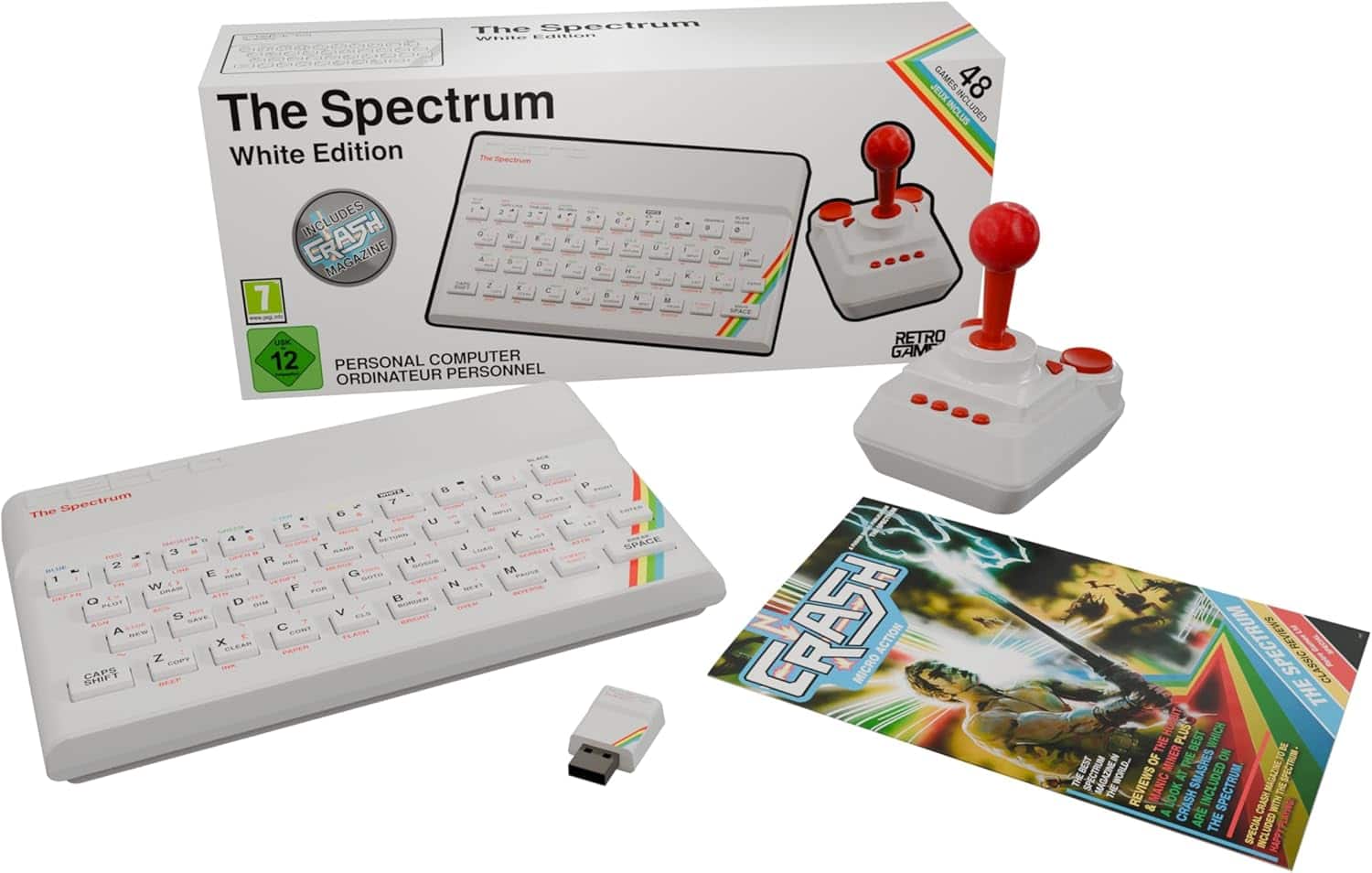
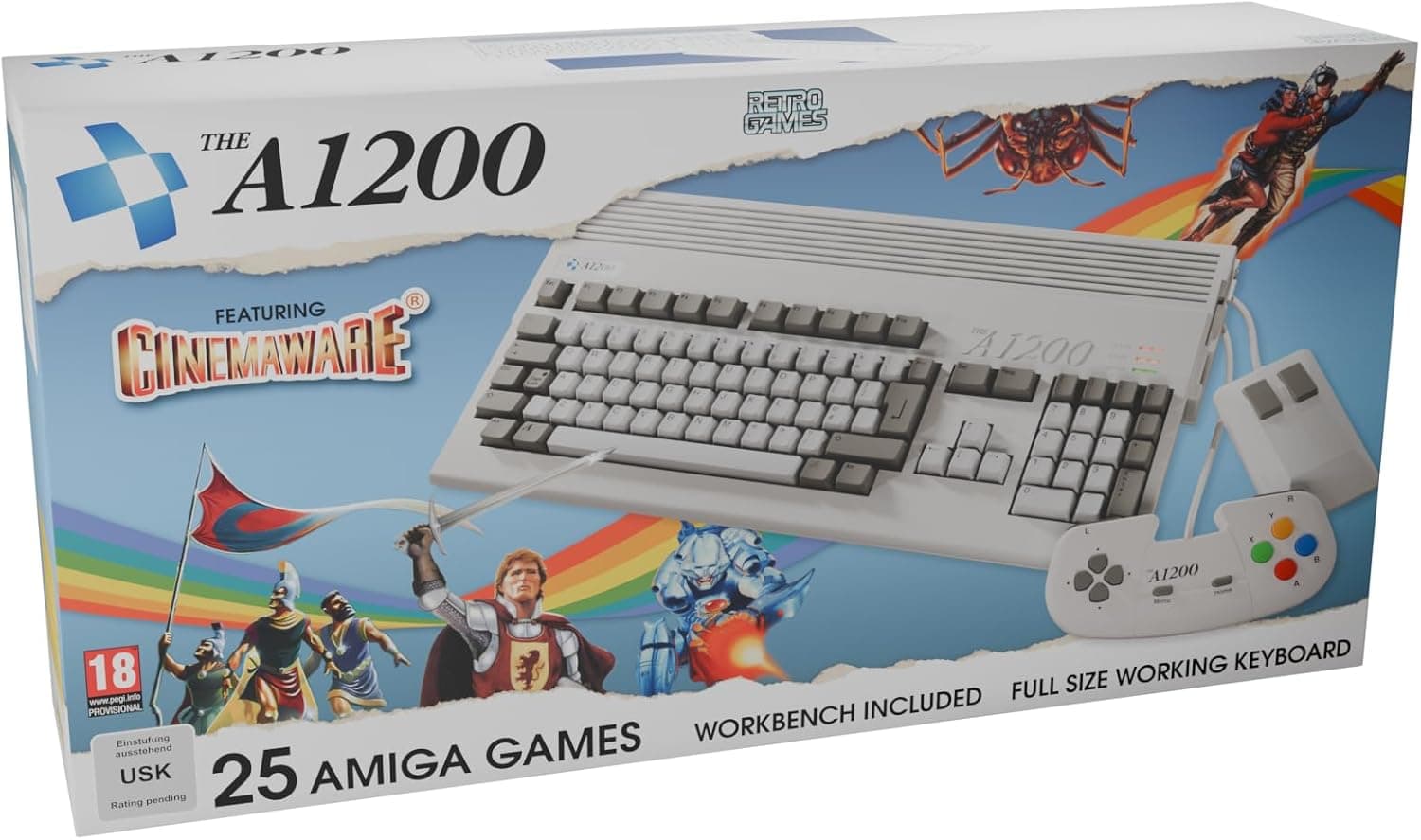
Having grown up mainly around the ZX Spectrum (the ZX81, the 48K, 48K+ and the +2A), it makes me happy to see companies releasing authorised modern equivalents of these 8-bit masterpieces (we have the Commodore 64 Ultimate and 64C Ultimate, the Amgia A1200, and the ZX Spectrum Next).

I must admit I like the idea of this white ZX Spectrum based on the rubber key variety. It’s been fully updated with HDMI and modern inputs including USB-A ports. £129. I’d also like to own the Amiga A1200 (£169) as there was no possible way of owning one back when I was a kid – it was far too expensive (as was the BBC Micro which had the best keyboard of any of the 8-bit computers).

However, even if I had the budget for them, I don’t have the space as it is. I’ve also feel that I’ve moved on quite a bit from the 8-bit retro gaming scene (though I occasionally yearn for a quick go at Chuckie Egg). Things got really interesting when I moved up to an Amstrad PC3086. It didn’t have a hard drive, but it did have two types of floppy drive and you could easily play decent games thanks to its VGA graphics (which was fancy at the time – especially at that price point) even if you had to keep swapping disks out every so often.

Ah, the memories.. but it was a right bugger to type on

But it’s great that there are companies out there that cater to those who are nostalgic for the good old days of gaming and programming. It makes us appreciate what we had before all the nonsense that we have now (Windows 11, I’m looking at you).

The Atari ST or the Amiga A1200 was THE ultimate gaming machine back in my day

Harry Pothole and Money Pit of Gloom

I don’t want to be a downer for the new Harry Potter TV series from HBO Max. Clearly, many people have put a substantial amount of effort into it, as have the people who helped make the film series (like me). But given both Warner Bros. and Paramount’s debt, it doesn’t seem likely to me that either can go on continuing to spend substantial sums of money on flogging remakes or continuations of franchises such as The Lord of the Rings without something giving way.

I’m concerned that, in several years, either WB or Paramount (or the combined entity) will eventually succumb, leading to IP asset stripping and being sold to the vultures that I’m sure are circling the properties of both companies as I type this. It wouldn’t surprise me that a company like Netflix couldn’t then just swoop in and bag those properties for themselves at a price substantially cheaper than what it would have cost them to have bought Warner Bros. in the first place.

We’ve seen in recent days that you can’t take anything for granted. Epic Games, makers of Fortnite and a former potential employer from last year when I applied for a data wrangling job within their Metahuman division, announced on Tuesday that they are laying off 1,000 employees because people weren’t engaging enough with Fortnite. What hasn’t helped is Epic fighting (and subsequently spending a shit load of money on) Apple and Google over third-party payments and stores in Apple’s and Google’s ecosystems.

A week earlier, Sony Pictures announced the imminent closure of Pixomondo, the visual effects company responsible for film and television visual effects on major series, including virtual production on recent Star Trek series such as Discovery, Strange New Worlds, and Starfleet Academy (which in itself has just been cancelled by Paramount within the past week). Some of the company will be absorbed into Sony Pictures Imageworks – but I’d certainly expect to see a substantial number of layoffs as a result.

Creative Corporate America seems to be suffering from Shit Hitting The Fan syndrome at the moment. Spending more money than is being earned (“Annual income twenty pounds, annual expenditure nineteen nineteen six, result happiness. Annual income, twenty pounds, annual expenditure, twenty pounds nought and six, result misery.”The Micawber Principle) and subsequently flailing (and failing) to find the right investors who will bring them back on track, even after restructuring.

And all of this is not helped by a certain useful idiot causing worldwide economic chaos because nobody will tell him “no”.

Two weeks in the new job…

… and things are going well.

Still lots to learn, but I have spent a good chunk of the past two weeks on induction courses and getting set up. This is the largest organisation I’ve worked for so far, so things can take a little while to get used to organisational processes, etc.

View from the 9th floor staff break-room

It’s quite strange in many ways. I’ve been used to being on-site all the time at Supermassive Games, but here it’s hybrid (50% in the office, 50% at home). And many of my colleagues work almost entirely from home or have very limited time in the office. There are advantages to doing so (no commuting!), and I was hybrid working at Memset and KPS for a long while. But that also comes with a few challenges.

Working as a team feels entirely different when everybody works in different places than when you’re working together on-site. Then there is the equipment. Where I work is now 100% hot desking, organised vaguely by department. You need to book your desk in advance (though I’ve encountered people at the desk I’ve booked on several occasions, which subsequently leads to awkward conversations). The downside to this is that even if you’re in the office, you’re not always going to be seated near your colleagues.

The monitor(s) at the desks are only HD-capable and much smaller than I expected. Whereas at home, I have a 27″ monitor that’s capable of a 144Hz refresh rate and gives me decent screen real estate with the M4 Pro MacBook Pro that I’ve been given. This is essential for working with the support ticket system, which is rather.. limited.. in how it handles its overviews and dashboards. The higher the resolution and the bigger the monitor, the better the experience is.

There are some other things that just come with working with a much larger, older and well-established institution than I’ve been used to working for so far, but these are just part and parcel, and you’ll get used to them quickly. Patience is a virtue, as they say.

Just like my days at Albatross, the office has a shop attached to it..

However, the benefits far outweigh any small issues, and one has access to the entire Adobe Creative Suite for personal use at home (at least a £65/month benefit in its own right), Apple Store educational discounts, and up to £2,000 in salary-sacrifice vouchers for lots of things. And that’s really only the start. Working in education has substantial perks versus many other places I’ve worked for, that’s for sure.

During the first week, I decided to treat myself to an overnight stay at The Hub by Premier Inn in Farringdon (Old Bailey) as it was cheap(ish). This particular branch gives you a digital key via Apple’s Wallet so that you can check in via the Premier Inn app, and once your room is available, it pops up on the Apple Wallet, and you can use your iPhone or Apple Watch as your room key. The bar is decent, and the breakfast (at a reasonable £8) is good and filling. Would recommend to those who are looking for a decent, but basic, stay in London.

As for London itself, having worked in Wardour Street for MPC between 2002 and 2008, things have certainly changed. I’ve yet to tell for the better or worse, but what I will say is the number of maniac cyclists shooting up and down High Holborn and going through red lights is excruciating to watch. But there are plenty of places to get a bite to eat at lunchtime. And places to go too. I had considered joining the London Library as that’s not far away, and would be a brilliant place to hang out, but I can’t justify its monthly fee given the number of books I currently read (and I tend to pick up e-books that interest me on Amazon for 99p when they go on sale). Then there’s the mortgage, which is due to go up by close to £200/month in June because of the UK economy and Trump being an arsehole with his wars.

Overall, I’m starting to get on with the job. Slowly, but surely. It’s nice to feel wanted again, and it’s allowed me to find my passion for WordPress and CMSes again. Hence, you’ll find a lot of older articles gone as I’ve moved away from WordPress.com and back onto my own server, where I’m managing the hosting stack myself again. I’ve spent most of last weekend getting re-acquainted with RHEL and specifically Apache again (whereas for the past 3 years it’s effectively been nginx and Ubuntu).

Martyn’s Movie Watch…
Les Visiteurs * Les Visiteurs II

Finally, a couple of films I’ve been watching during my downtime. I’ve seen Les Visiteurs many moons ago, but I don’t believe I ever saw its sequel. Rewatching the first film reaffirmed why I liked it the first time around – it’s stone cold bonkers. Christian Clavier, who co-wrote the film, is clearly having the time of his life playing the serf to Jean Reno’s medieval knight who has to travel through time to stop himself killing his father-in-law, whom he thought was a bear – all because he captured a witch who poisons his water when he’s not looking. Alas, the wizard he uses to fix the problem sends him and his serf 1,000 years into the future… and hilarity begins.

It’s a genuinely funny film and still holds up 30 years later. Its sequel, Les Visiteurs II, is more of the same, though I’d say it’s even more chaotic and maybe even funnier. There’s a whole sequence when Clavier’s serf blows up a television, causing the entire front room to explode. Subsequently, there’s an entire sequence featuring firemen putting out the fire, which is – somehow – even MORE chaotic, and I haven’t laughed that hard for some time.

I love both these films. They’re proper farces, and everybody involved with them looks as if they’re having the time of their lives. Combine it with a great soundtrack, and you’ve got a couple of great films that – if you’re willing to put up with subtitles – are well worth your time.

I’ve still yet to see the third (and possibly final) film – Bastille Day, but that’s for this weekend.